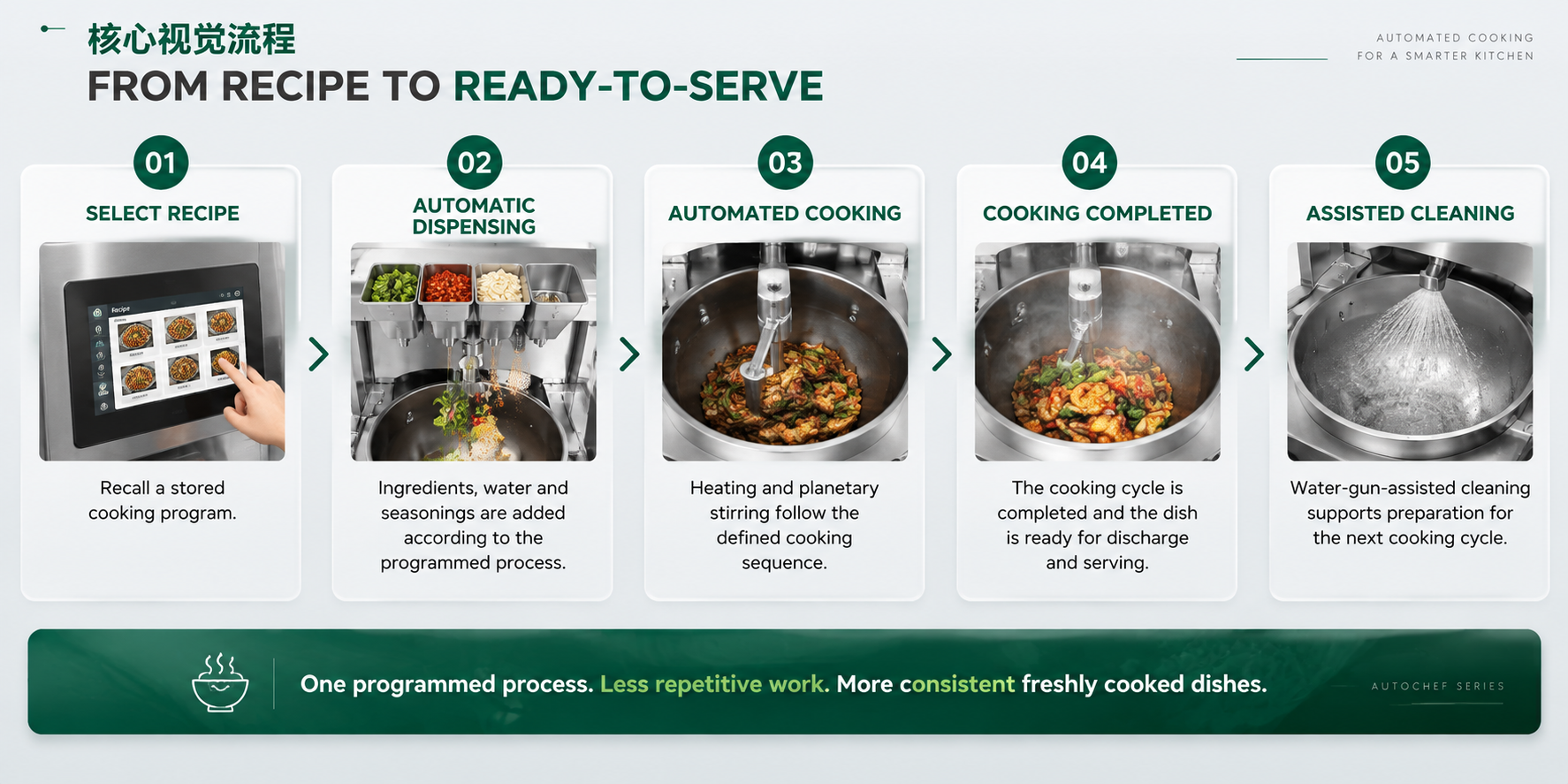
Automatic cooking can reduce repetitive stirring and help a restaurant group execute defined recipe stages more consistently. The useful project question is not simply whether a machine can stir and heat. It is whether the real dish can be converted into a controlled process without losing the required food result or creating awkward manual handoffs.
UCOOK's current fully automatic cooking machine is listed with a 16 L vessel, Ø400 mm wok, recipe-based touchscreen and automatic stirring. These are product references, not promises of usable batch size, output, labour savings or suitability for every recipe.
1. Start with a representative menu, not a machine feature list
Select a small group of dishes that represents the intended operation. Record each recipe from prepared ingredients to finished discharge, including the points where an experienced cook currently changes heat, adds ingredients, stirs, checks texture or makes a visual decision.
- Food type and finished quality standard
- Ingredient preparation and loading sequence
- Working batch and order pattern
- Heat, time and stirring stages
- Manual judgment points that cannot yet be converted into a rule
A recipe that changes substantially with ingredient condition or relies on continuous chef judgment may need more development before automation than a stable, repeatable process.
2. Define the automation boundary for every stage
| Process stage | Buyer input to confirm | Why it changes the project |
|---|---|---|
| Ingredient preparation | Cut, portion and holding condition before loading | Sets the real starting condition and operator workload |
| Loading and additions | Manual, assisted or project-specific dispensing for each ingredient | Prevents an unclear “fully automatic” claim from hiding manual handoffs |
| Heating and stirring | Stage sequence, movement need, texture target and judgment points | Guides recipe programming, stirring review and validation work |
| Discharge and serving | Receiving container, portion workflow and operator position | Affects machine orientation, clearance and downstream flow |
| Cleaning and changeover | Residue, allergen or flavour change, wash routine and available time | Determines whether the planned menu sequence is operationally practical |
3. Treat batch size, wok geometry and stirring as one decision
Nominal vessel capacity is not the same as usable working batch. Ingredients need appropriate headspace and movement, and different foods respond differently to contact, folding, tossing or continuous stirring. The wok, stirring tool, speed logic, load and programmed stages should therefore be tested together around representative recipes.
For larger liquid or sauce-heavy production, compare an automatic cooker with a tilting kettle or bratt pan instead of assuming that one vessel format fits every batch process.
4. Map the operator workflow around the machine
Automation still needs people, ingredients and safe space. Show where prepared ingredients wait, who selects the recipe, how exceptions are handled, where the finished food is received and how staff move during loading, discharge and cleaning.
- Ingredient staging and container sizes
- Operator reach, visibility and control access
- Hot-food receiving and portion path
- Cleaning water, drainage and residue handling
- Service access that remains clear during operation
- Staff training and recipe-change authority
5. Confirm site utilities before the layout is fixed
Provide the installation country and confirmed voltage, phase and frequency, together with the available space and adjacent equipment. Water, drainage, ventilation or extraction requirements, cleaning boundaries and final connection responsibility must be reviewed for the actual project and local conditions.
The equipment should be placed inside the wider automated cooking workflow, not added after preparation, holding and service paths have already been fixed.
6. Validate recipes before scaling to multiple sites
A project trial should record the exact recipe, ingredient condition, batch, program revision, operator actions and observed result. If an ingredient, step or parameter changes, keep that change linked to the next review instead of treating one successful demonstration as a finished multi-site standard.
Distributors and project contractors should also identify who owns recipe approval, staff training, document updates and post-installation support. UCOOK can review the equipment and project interfaces, while the buyer controls its recipes, operating standards and local approvals.
7. Send a quotation brief that can be reviewed
Share the target menu, two or three representative recipes, working batch, order pattern, ingredient-loading boundary, discharge and cleaning method, country, voltage, phase, frequency, quantity, layout and target date. Photos or a simple workflow sketch can clarify the operator handoffs without disclosing confidential recipes.
Frequently asked questions
Does an automatic cooking machine automate every ingredient-loading step?
Not necessarily. Ingredient preparation, loading, liquid or seasoning addition and discharge can remain manual, assisted or project-specific. Define that boundary for each recipe before equipment selection.
Can one automatic cooking machine run different recipes?
Recipe programs can organize different cooking stages, but each dish still needs process development and validation for its ingredients, batch, stirring, heat response and finishing standard.
Does a 16 L vessel equal a 16 L working batch?
No. The listed 16 L is a product reference. Practical working batch depends on the food, expansion, required headspace, stirring action and approved process.
What should a buyer include in an automatic cooking machine RFQ?
Send the menu or representative recipes, batch requirement, ingredient and discharge workflow, cleaning method, country, voltage, phase, frequency, quantity, available space and target date.
Begin with one representative dish and its real operator handoffs. That process record makes the equipment, program and project discussion more useful than a generic request for “full automation.”