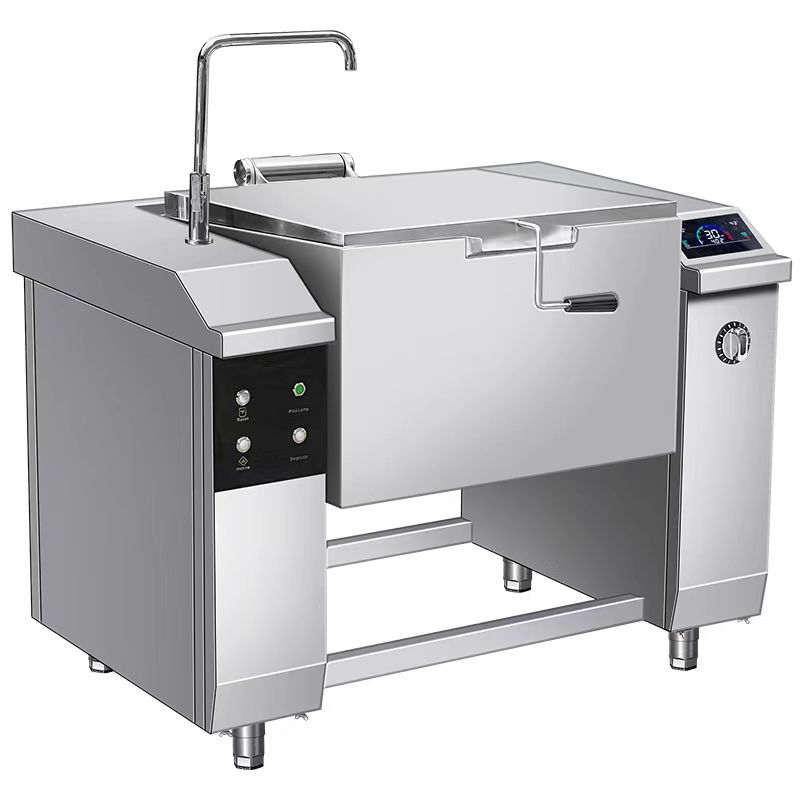
A procurement team may ask for a large kettle when the process needs a broad cooking surface, or request automation before defining the recipe steps it should control. Both mistakes begin with an equipment name instead of the food process.
UCOOK uses the menu, batch range, operator sequence, discharge method, cleaning plan and available utilities to narrow the platform. Final ratings, dimensions and functions are confirmed only after the project brief is reviewed.
1. Start with the food transformation
Document what happens from loading to discharge. Liquids that are heated, simmered or mixed place different demands on a vessel than products that are seared, reduced, braised or turned across a broad surface. A programmed stir-fry process adds another layer: timed steps, movement and repeatable execution.
Include the representative batch range rather than one maximum number. Food depth, viscosity, solids, sticking risk and sensitivity to agitation can change the useful operating window. These are selection inputs, not universal performance claims.
2. Compare the platform roles
| Platform | Best starting question | Key interfaces to confirm |
|---|---|---|
| Tilting kettle or boiling pan | Is the process mainly heating, simmering, mixing or holding a vessel-based batch? | Vessel geometry, agitation, fill range, discharge, cleaning and utility supply |
| Tilting bratt pan | Does the menu need a broad working surface for frying, braising, boiling or multi-process production? | Surface area, product depth, zone use, tilting path, drainage and operator access |
| Automatic cooker | Which repeatable recipe steps should the machine execute or assist? | Ingredient handling, movement, program stages, sensing, discharge, cleaning and data needs |
3. Let discharge and downstream work influence the choice
Tilting can reduce manual ladling or lifting, but the project must still define receiving containers, trolley height, discharge direction, splash control and the space operators need. A thick product, a free-flowing liquid and a portioned dish will not leave the vessel in the same way.
Map what happens next: holding, packing, blast chilling, serving or transfer to another process. The receiving step can change the useful vessel position, batch size and layout.
4. Define what automation actually controls
Automation is more useful when the process is explicit. List the stages an operator performs, the decisions that rely on food condition, and the steps suitable for programmed timing, heating, movement or dispensing. A machine cannot standardize an undefined recipe.
For repeatable menus, review UCOOK's automated cooking systems and fully automatic cooking machine. For flexible batch production, start with tilting and batch-cooking platforms.
5. Treat cleaning and service access as selection criteria
Cleaning method affects vessel shape, drain position, lid and mixing-tool access, water use and the time between batches. Ask who removes food residue, how the vessel is rinsed, whether tools are removable and which areas need inspection before the next production cycle.
Maintenance access matters too. Controls, motion systems, sensors, heating components and service connections must remain reachable after the machine is installed. These requirements belong in the project layout and the engineering and quality review.
6. Use a food-safety management system, not an equipment promise
The U.S. FDA's 2026 Food Code is a model code for retail and foodservice authorities and introduces a food safety management system concept focused on preventive control. It does not make one appliance compliant, and local adoption and requirements vary. The operator and responsible local parties must define the actual food-safety plan, monitoring and records for the destination market.
7. Send a procurement brief that can be engineered
- Application, country, menu and representative products
- Typical and maximum batch range
- Required cooking, mixing, tilting and discharge steps
- Confirmed power supply: voltage, phase and frequency
- Expected quantity and project timing
- Cleaning method, drainage and available water
- Operator workflow and downstream handling
- Automation, recipe, interface or data expectations
- Installation, ventilation and service constraints
Frequently asked questions
Is a bratt pan the same as a tilting kettle?
No. Their capabilities can overlap, but vessel geometry, cooking surface, agitation, discharge and intended food processes differ. Selection should start with the actual menu and workflow.
When does an automatic cooker make more sense than a manual vessel?
Automation becomes relevant when the process benefits from repeatable programmed stages, controlled movement or ingredient handling. The business case still depends on menu stability, operator workflow, cleaning and production volume.
Can capacity alone determine the correct batch-cooking machine?
No. Usable batch range, food behavior, heat input, mixing, discharge, cleaning, utilities and the required cycle all affect the final equipment choice.
What should be included in a batch-cooking RFQ?
Share the application and menu, representative batch range, required process steps, power and voltage, quantity, discharge and cleaning method, site conditions and any automation or data requirements.
Source note
The food-safety context above is based on the official FDA Food Code 2026 and its release notice. These external references inform project questions; they are not evidence of UCOOK product certification or performance.
The best machine is the one whose vessel, controls and workflow match the food process. Share the application, supply, quantity and batch sequence; UCOOK can identify which inputs still need confirmation before a proposal.