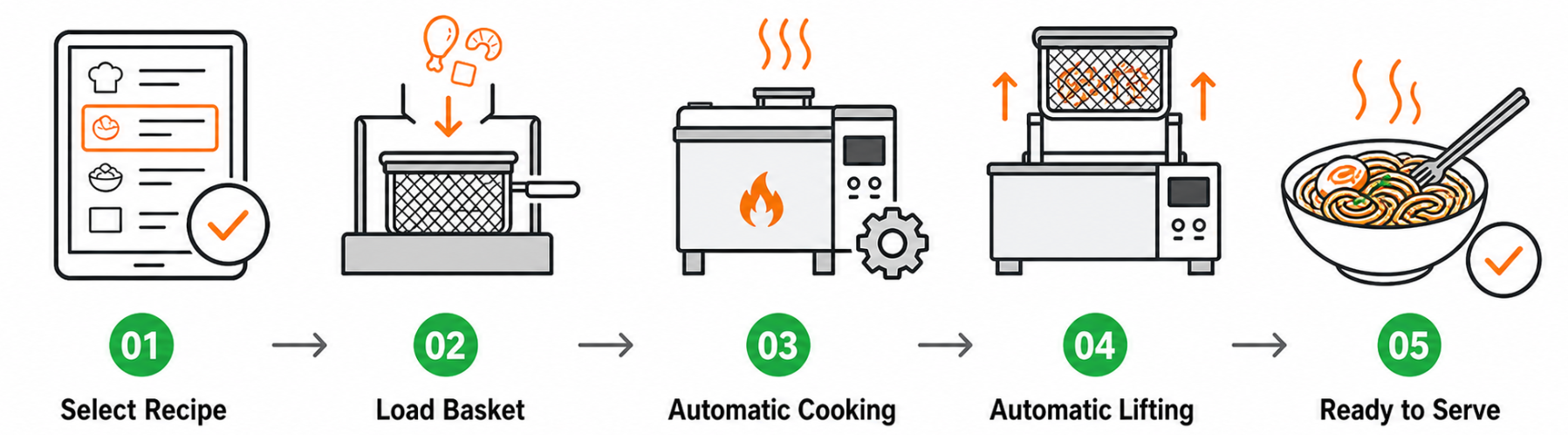
Automatic lifting can remove repetitive timing and basket handling from a noodle station. It does not remove the need to define the real service process. The useful machine is the one that fits the recipes, peak order pattern, water management and available kitchen space.
UCOOK reviews the operating brief before confirming a configuration. Final dimensions, heating arrangement, controls and utilities remain project-specific.
1. Map the peak service window
Start with the busiest realistic period rather than an average day. Record how many portions enter the station, how often different noodles run at the same time, whether products share one water condition and where cooked portions move after lifting.
- Representative noodle types and portion sizes
- Cooking time for each menu group
- Peak orders and simultaneous basket demand
- Blanching, rinsing, draining and finishing sequence
- Operator count and movement around the station
2. Compare 3- and 6-basket workflows
| Decision area | 3-basket starting point | 6-basket starting point |
|---|---|---|
| Menu and volume | Focused menu or moderate concurrent cycles | More simultaneous cycles or a broader timed menu |
| Operator workflow | Compact station with fewer active positions | Higher coordination demand across cooking, draining and finishing |
| Site planning | Review available width, supply and drainage | Confirm the larger service envelope, electrical load and water handling |
| Project question | Will 3 active baskets cover the real peak sequence? | Can the site and team use 6 baskets without creating a downstream bottleneck? |
Basket count is not a guaranteed output figure. Portion size, cook time, loading pattern, recovery demand and operator sequence determine the result in the actual application.
3. Choose controls from menu complexity
A button-control automatic noodle cooker suits a direct workflow where operators need clear independent timing and lifting. A touch-control automatic noodle cooker can organize stored programs and status information for a wider recipe set.
Before selecting the interface, define who creates or changes programs, how mistakes are prevented, which languages are needed and how staff will be trained. Controls should simplify a known process rather than add functions that the kitchen will not use.
4. Define water, drainage and optional agitation
Water supply, refill behavior, overflow, foam, starch accumulation and drainage affect daily operation. The project brief should identify the local water and drainage conditions, cleaning routine and whether the menu benefits from water movement that helps separate noodles after immersion.
Optional water agitation or similar functions must be reviewed with the tank, product and operating sequence. They should not be assumed to suit every noodle or every installation.
5. Protect ergonomics and downstream flow
Review loading height, basket handles, hot-water exposure, drainage time, receiving containers and the path from cooker to seasoning or serving. A higher basket count only creates value if the surrounding station can handle the lifted portions safely and without delay.
For distributor or contractor projects, coordinate the cooker with preparation benches, refrigeration, finishing equipment, extraction where applicable and service access. The machine belongs inside a kitchen workflow, not in an isolated product list.
6. Confirm the electrical and installation brief
Provide the country and confirmed voltage, phase and frequency before quotation. The heating system, simultaneous use, controls and site circuit must be reviewed together. Do not select a configuration from a plug photo or a nominal voltage alone.
- Country and installation address or market
- Confirmed voltage, phase and frequency
- Available circuit and connection responsibility
- Water inlet, pressure information and drain position
- Machine space, access route and adjacent equipment
- Quantity, branding, documentation and target date
7. Send an RFQ that supports a useful proposal
A short video of the current noodle workflow, a menu with cooking times, the proposed kitchen layout and the confirmed utility schedule are more useful than asking only for a “6-basket price.” UCOOK can then identify the missing decisions before a product or project proposal is prepared.
Frequently asked questions
Should a buyer choose a 3- or 6-basket automatic noodle cooker?
Choose from peak order flow, recipe mix, simultaneous basket use, operator movement and available utilities—not basket count alone. A 3-basket unit may suit a focused menu, while a 6-basket layout can support more concurrent cycles when the site and workflow are designed for it.
What is the difference between button and touchscreen control?
Button control supports direct, simple timed operation. A touchscreen can organize multiple stored programs and clearer status information. The right choice depends on menu variety, training needs and the operating process.
Can each basket use a different cooking time?
Independent basket cycles can be configured on suitable projects, but the required timing, lifting sequence and control method must be confirmed before the machine specification is released.
What information is needed for an automatic noodle cooker quotation?
Share the menu and noodle types, expected peak workflow, basket quantity, preferred controls, country, voltage, phase and frequency, water and drainage conditions, quantity, available space and target date.
Start with the actual peak sequence. UCOOK will help turn the menu, utilities, quantity and workflow into the next set of equipment decisions.